
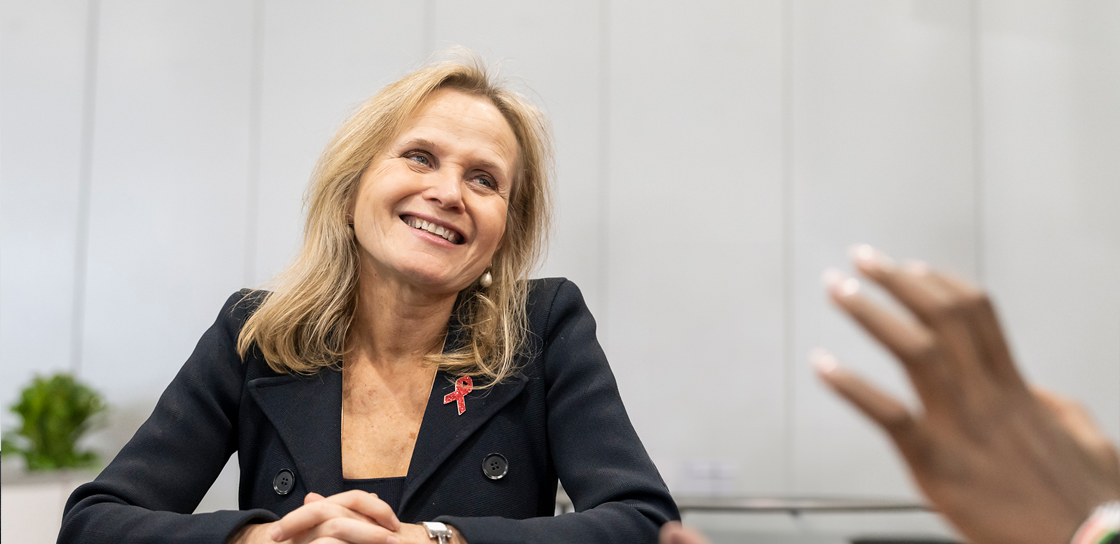
We spoke with IAS President Sharon Lewin about what she is most looking forward to at AIDS 2024 and key moments in her presidency.
What are the biggest challenges facing the global HIV response?
A main challenge is the funding gap, which affects access to treatment and prevention, as well as efforts to address the persistent stigma around HIV.
The global decline in human rights further marginalizes key populations, such as men who have sex with men, sex workers, trans people and people who use drugs. Only by uniting science, policy and activism can we move forward in ending HIV as a threat to public health and well-being.
What is the role of the IAS in attaining the vision of ending HIV as a threat to public health and individual well-being?
The IAS unites the HIV response. It brings together scientists, policy makers and activists to galvanize the scientific response, build global solidarity and enhance human dignity for all those affected by HIV.
The IAS does this by hosting three of the most important global conferences and developing thematic programmes that aim to close scientific gaps, disseminate the latest research and improve health services.
What are you most looking forward to at AIDS 2024?
I'm excited about the latest in HIV cure, groundbreaking studies on HIV treatment and prevention, and innovative community-led programmes that put people first.
The Global Village is always a highlight, and this year marks its 20th anniversary of showcasing how science translates into community action. Don't miss it!
I am also excited to be in Munich. It’s a great city with a complex and somewhat dark history, but a commitment to being inclusive and green and forward looking.
As you prepare for your last conference as IAS President, can you share the achievements you are most proud of during your presidency?
During my tenure, we instituted a global rotation pattern for our conferences to ensure that all our conferences, even the biggest meeting AIDS, are held where we can have the biggest impact. I'm also proud that the IAS leads in using non-stigmatizing, people-first language. The IAS is in a sound position financially and has a dynamic, forward-thinking and very engaged Governing Council that can truly speak for our members.
I am also proud that the IAS is committed to advancing the most important scientific challenges of our time – finding a cure and a vaccine. I am proud of the IAS expanding our highly successful research academies to include both cure and vaccine science with both meetings held in Africa.
As Chair of IAS 2023 in Brisbane, I will always remember the elation at the announcement that Sydney was the first city to virtually eliminate HIV transmission and that Australia, my home country, could become the first country to reach this milestone. This was an inspiring moment for every delegate, and I hope it continues to inspire every city and every country to know that the virtual elimination of HIV is truly within reach.
What is your message to the world as you prepare to hand over the reins of the IAS to your successor?
As I prepare to step down, I’m optimistic about the future of our global HIV response. There is still much to do, and collaboration between science, policy and activists is crucial. The scientific advances in the HIV field over the past four decades have been breathtaking. Long-acting antivirals hold great promise to further transform treatment and prevention. I hope that we continue to see similar revolutionary advances in the future to deliver a cure and a vaccine and that any new product is rapidly available globally.
AIDS is not gone; we must, and we can, continue our mission. I look forward to seeing you all at AIDS 2024 as we advance this important work!